Physical Address
304 North Cardinal St.
Dorchester Center, MA 02124
Physical Address
304 North Cardinal St.
Dorchester Center, MA 02124
By 5 PM, your body has likely taken on a physical “imprint” of your workday. Your shoulders have crept up toward your ears, your neck is jutted forward in a classic “tech-neck” pose, and your lower back feels like it’s been compressed by hours of sitting. We often think of stress as something mental, but for the remote professional, stress is a physical stowaway that hides in the tight muscles of your upper back and the shortened fibers of your hips.
Your body holds onto the tension of every difficult email, every complex spreadsheet, and every back-to-back Zoom call. When you finally close your laptop and try to transition to rest, this physical armor doesn’t just disappear. It stays with you, sending constant “low-level pain” signals to your brain that keep your nervous system in a state of hyper-vigilance. You can’t expect your mind to shut down when your body is still screaming that it’s under pressure.
Releasing these “keyboard kinks” isn’t just about comfort; it’s a vital biological signal to your brain that the workday is officially over. By performing targeted desk stretches, you can physically “un-plug” the stress sensors and pave the way for a deeper, more restorative night. Let’s look at how to strip off your workday armor and prepare your body for the weightlessness of sleep.
The most critical area for the sedentary worker is the hips. When you sit, your hip flexors are in a constantly shortened position. This “survival posture” is biologically linked to the “run” part of “fight or flight.” Your brain interprets tight hips as a signal that you are ready to bolt from danger. Consequently, your body stays in a state of hyper-vigilance. This makes it incredibly difficult to reach the deep, restorative stages of sleep where physical repair happens. Stretching your hip flexors—specifically the psoas muscle—can have a profound effect on your overall stress levels. It is like releasing the parking brake on your relaxation response. According to Healthline, regular “deskercises” that target the hips and lower back can reduce cortisol levels and improve sleep onset latency. By opening up your hips, you are telling your brain that the “threat” of the workday is officially over.
Another victim of the home office setup is your chest and upper back. The “tech neck” posture—shoulders rolled forward and head tilted down—constricts your diaphragm and reduces your respiratory efficiency. When you breathe shallowly into your upper chest, you reinforce the stress response. This shallow breathing often carries over into your sleep, leading to lower oxygen saturation and more frequent mini-awakenings. Opening up your thoracic spine and stretching your pectoral muscles allows for deeper, more diaphragmatic breathing. This shift activates the vagus nerve, the primary driver of the parasympathetic nervous system (the “rest and digest” mode). If you have experimented with the techniques in our guide on Progressive Muscle Relaxation, you know how powerful physical release can be. Thoracic stretching is the “daytime anchor” for those nighttime relaxation practices.
How much “body armor” are you carrying right now? Take a moment to scan your body and rate your tension on a scale of 1 to 5:
If you are at a 3 or higher, your physical tension is actively sabotaging your sleep quality. You are not just tired; you are physically “tight,” and that tightness is keeping your brain from shutting down.
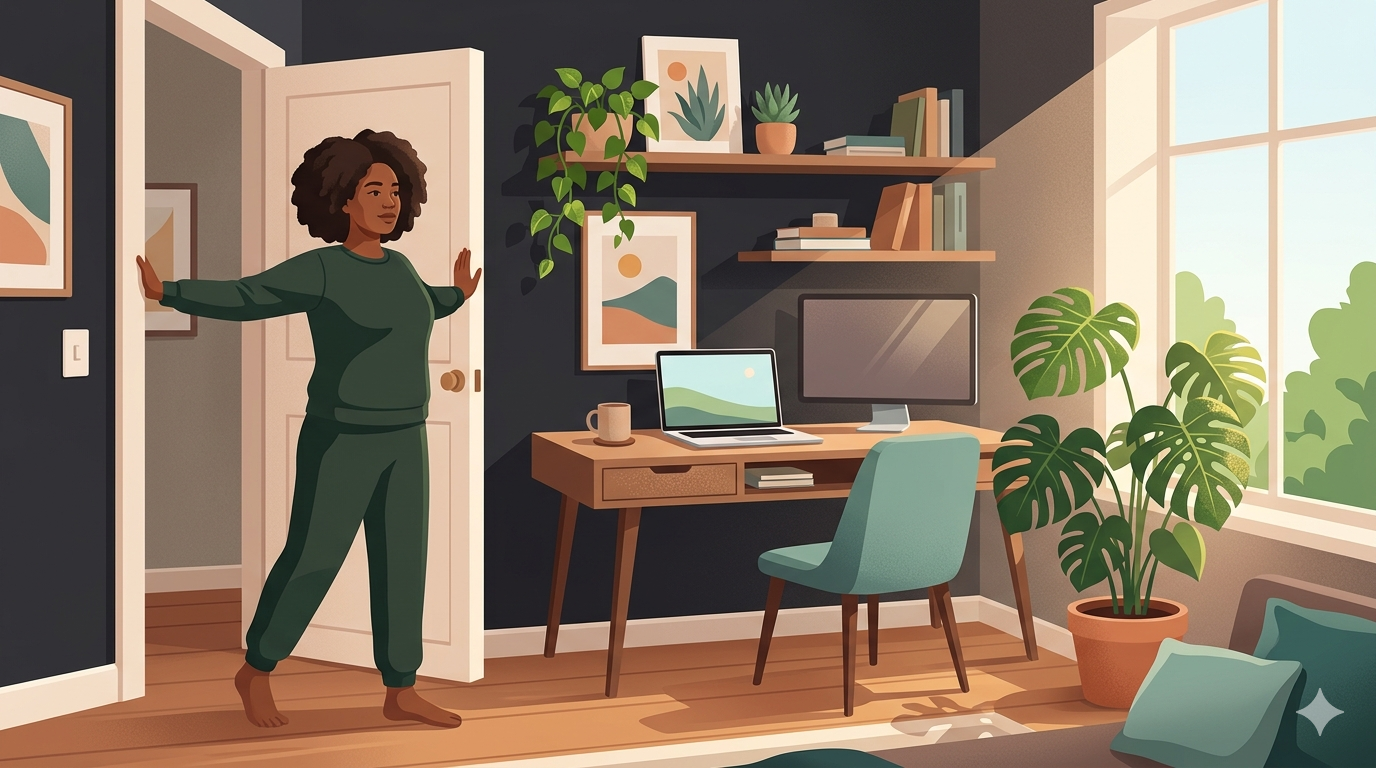
The human body was not designed to sit for eight hours straight. To combat fascia thickening, implement the pillar of the “90-Minute Reset.” Every 90 minutes, set a timer and step away from your desk for just three minutes of targeted stretching. This short burst is enough to interrupt the “setting” process of your connective tissue and provide a neurological reset. Focus on three key areas: the neck (gentle rolls), the chest (doorway stretch), and the hips (standing lunge). This consistent “micro-dosing” of movement ensures that you do not reach the end of the day with a body that feels like a solid block of wood. It keeps your nervous system in a state of “fluidity” rather than “rigidity.”
Since the hips are the “emotional warehouse” of the body and the primary signalers of stress, the Crescent Lunge (or a simple standing hip flexor stretch) should be your non-negotiable desk stretch. While standing, step one foot back into a lunge and gently tuck your pelvis under. You should feel a deep pull in the front of your back hip. Hold this for 45 seconds per side. This simple act releases the psoas and tells your adrenal glands to stop pumping out cortisol. It is the most effective way to “de-arm” your survival response during the workday. By the time you reach your bedroom, your hips will be open and ready for the physical stillness of sleep.
To counter the “hunched over” posture, use the pillar of “Thoracic Extension.” This can be done in your chair. Interlace your fingers behind your head, lean back over the top of your chair, and look toward the ceiling while taking a deep, diaphragmatic breath. This opens the chest, stretches the intercostal muscles between your ribs, and reverses the “collapse” of your posture. It immediately improves your breathing capacity and lowers your heart rate. Think of it as a physical “deep breath” for your entire upper body. This openness translates into a more relaxed respiratory pattern during the night, reducing the likelihood of restless tossing and turning.
Sometimes, tension is not just in the muscles but in the nerves themselves. “Nerve gliding” involves gentle, rhythmic movements that help nerves slide through their surrounding tissue. For the remote worker, “median nerve gliding” (for the arms and wrists) and “sciatic nerve gliding” (for the legs) are essential. These movements reduce the “tingling” or “numbness” that can keep you awake at night. They are subtle, non-strenuous, and incredibly effective at calming an overactive nervous system. When your nerves can “glide” freely, they stop sending the “emergency” signals that prevent deep sleep. It is the ultimate “fine-tuning” for your physical recovery.
Your body is the vessel for your professional brilliance, but it is also the engine of your recovery. By treating your physical tension as a “business problem” to be solved, you unlock a new level of sleep quality. As a remote worker, you have the privacy and the space to implement these stretches without judgment. Use that advantage. Tomorrow, we will look at how to take these principles even further with a dedicated evening yoga routine. For now, stand up, reach for the ceiling, and feel the “armor” start to crack. Your bed is waiting, and tonight, you are going to be loose enough to actually sink into it.