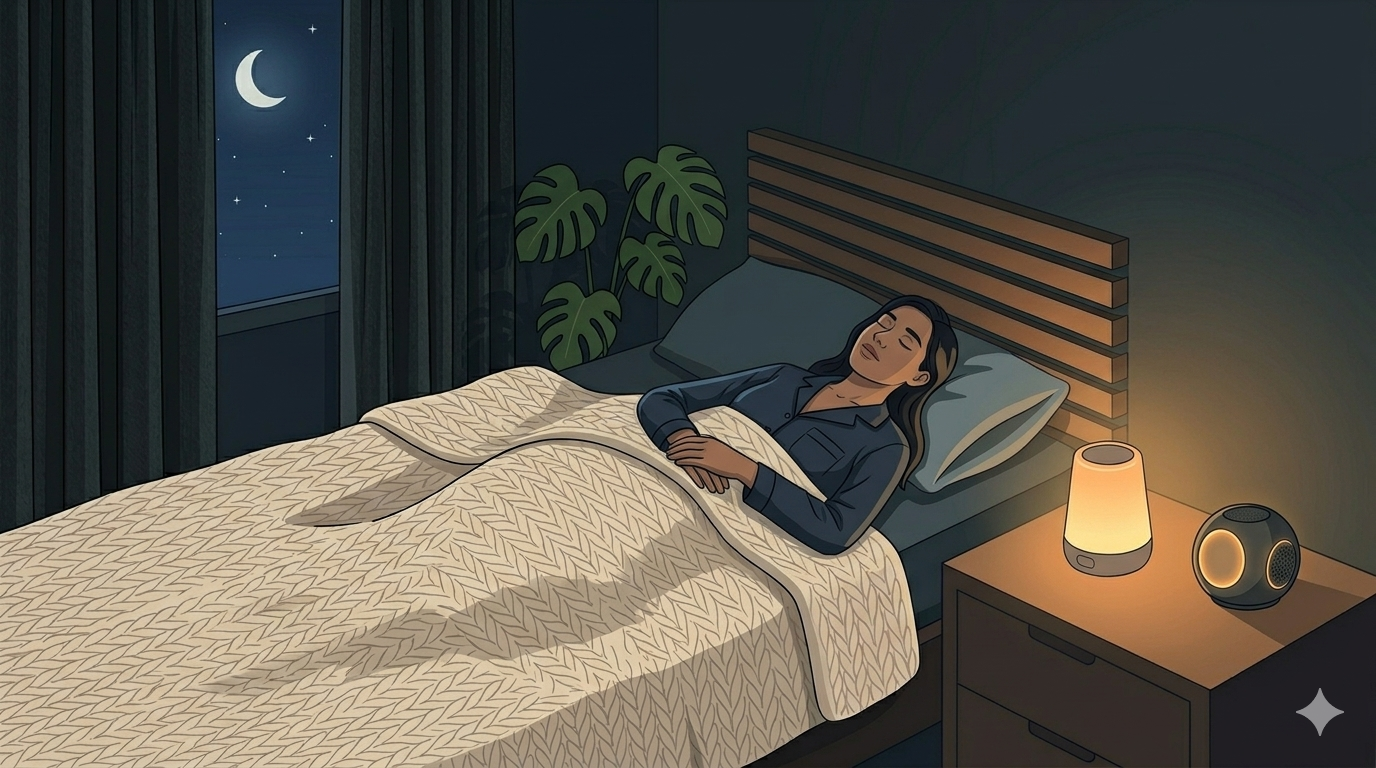
A peaceful lo-fi vector illustration of a person lying flat on their back in a cozy bedroom. Their eyes are closed, and their body looks completely relaxed and heavy on a thick teal blanket. A soft, warm amber glow comes from a bedside lamp. Through the window, a dark blue starry sky is visible. In the corner, a large Monstera plant adds a touch of nature. The room is calm, minimal, and serene. 2D digital illustration, wide 16:9, high contrast, no text

Progressive Muscle Relaxation: A Remote Worker’s Guide — How to Physically “Unclench” After a Day at the Desk

The Desktop Armor: Why Your Body Stays Tense After Work

Take a moment right now. Specifically, where are your shoulders? Are they tucked up near your ears? Alternatively, is your jaw clenched? Perhaps your eyebrows are furrowed as you read this. Utilizing Progressive Muscle Relaxation for sleep is the ultimate solution to this chronic physical tension.

For the modern remote worker, the “desk body” doesn’t just disappear when you close your laptop. Consequently, we spend 8-10 hours a day in a state of static tension, often because we haven’t succeeded in Creating Physical Boundaries between our office and our bedroom. Specifically, our shoulders are rolled forward, our necks are strained, and our core muscles are tight. This isn’t just a posture problem; actually, it’s a sleep problem. Your body is holding onto the “stress armor” of your workday. Therefore, when you lie down in bed, that armor doesn’t just fall off.

This state of chronic physical tension is a signal to your brain. If your muscles are tight, your brain assumes there is a threat. Consequently, it assumes you are still “in the office.” It believes you are still fighting for deadlines and needing to stay alert. Therefore, you can’t enter deep, restorative sleep if your body is still braced for a Slack ping.

Tonight, we’re going to explore Progressive Muscle Relaxation (PMR). This century-old technique is the perfect antidote to the “Desktop Armor.” Additionally, we’ll show you how to systematically release the physical tension of your workday. Ultimately, your body can finally signal to your brain that it’s safe to sleep.


The Physiology of the “Release” and Progressive Muscle Relaxation for Sleep

The Mind-Body Feedback Loop

The relationship between your mind and your muscles is a two-way street. While stress causes muscle tension, muscle tension also sustains stress. Consequently, this is known as the “Proprioceptive Loop.” When your muscles are tense, they send a constant stream of information to the amygdala. Therefore, you remain in a state of high arousal.

Progressive Muscle Relaxation, developed by Dr. Edmund Jacobson in the 1920s, works by breaking this loop. Specifically, by deliberately tensing and then suddenly releasing specific muscle groups, you are creating a “vivid contrast.” The sudden release of tension triggers the “Relaxation Response.” This is a physiological state characterized by a drop in blood pressure and heart rate. As we discussed in our guide on Work-Life Balance and Sleep, managing this transition is critical for long-term health.

The “Somatic” Off-Switch

For many remote workers, the transition from “work” to “life” is purely cognitive. However, we often try to think our way into relaxation. But PMR is a somatic tool—it uses the body to change the mind.

Research published in the Journal of Behavioral Medicine has shown that PMR is one of the most effective non-pharmacological treatments for insomnia. Specifically, it is highly effective for those whose sleep is disrupted by anxiety. By physically “unclenching” your body, you are manually flipping the switch on your Parasympathetic Nervous System. Consequently, this makes it biologically easier to drift off.


The Desktop Armor Diagnostic Scorecard

How much work-related tension are you carrying tonight? Score yourself on a scale of 1-5 for each statement (1 = Never, 5 = Every Day).

  1. The Shoulder Shrug: I notice my shoulders are hunched toward my ears when I’m focused on a task.
  2. The Jaw Clench: I catch myself grinding my teeth or clenching my jaw during or after work.
  3. The Desk Ache: I experience “phantom” tightness in my lower back or neck even when I’m in bed.
  4. The Restless Leg: I feel a “buzzing” or “fidgety” sensation in my legs when I try to lie still.
  5. The Shallow Breath: I notice my breathing is mostly in my chest rather than my stomach.

Scoring Your Stress:

  • 5-10: The Limber Leader. You have a healthy awareness of your body. Therefore, PMR will be a powerful maintenance tool for you.
  • 11-19: The Braced Professional. You are carrying significant workday tension into your evenings. Consequently, you need a daily PMR practice.
  • 20-25: The Desktop Statue. Your body is in a state of chronic “fight or flight” tension. Initially, immediate somatic intervention is required to protect your sleep.

The Four Pillars of Remote Work Progressive Muscle Relaxation for Sleep

1. The Physical Pillar: The “Toe-to-Head” Protocol

To be effective, PMR must be systematic. We recommend starting from your feet and working your way up.

  • The Routine: Lie flat on your back in bed. Initially, close your eyes.
  • Tense (5 seconds): Curl your toes tight. Feel the tension in your arches and calves.
  • Release (15 seconds): Suddenly “drop” the tension. Consequently, feel the blood rush back into the area. Notice the difference between “tense” and “relaxed.”
  • Move Up: Repeat for your thighs, glutes, stomach, chest, hands, arms, shoulders, neck, and finally, your face.

2. The Cognitive Pillar: The “Attention Anchor”

While you are tensing and releasing, your mind must be fully present in the sensation.

  • The Protocol: Focus entirely on the feeling of the tension leaving the body. Specifically, use words like “release” or “letting go” as you exhale.
  • Why It Works: This prevents your mind from drifting back to your inbox. Furthermore, you are giving your brain a high-intensity sensory task. This overpowers work-related rumination.

3. The Digital Pillar: The “Guided Unclench”

If you find it difficult to stay focused on the protocol, use a guided audio session.

  • The Tools: Use Headspace or Calm for their specific PMR modules.
  • The Remote Work Hack: Use an Essential Oil Diffuser with a calming scent like Lavender. Actually, this creates a “sensory anchor” for your relaxation practice.
  • The Data Connection: Use your Oura Ring or Fitbit Sense 2 to track your “Readiness.” Specifically, many users see an immediate improvement in their “Deep Sleep” metrics.

4. The Biological Pillar: The “Exhale Release”

The release phase of PMR should always be accompanied by a long, slow exhale.

  • The Routine: As you “drop” the tension in a muscle group, blow the air out of your mouth. For instance, act as if you are blowing through a straw.
  • The Science: A long exhale stimulates the Vagus nerve. Consequently, this further accelerates the transition into the Parasympathetic state. This is the physiological “double-tap” that ensures your body and mind are aligned for sleep.

Quick Wins for Tonight

  • The “Desk Reset”: If you can’t wait for bedtime, do a “mini-PMR” at your desk. Tense and release your shoulders after every meeting.
  • The Warmth Factor: Ensure your feet are warm. Specifically, wear socks or use a hot water bottle. Warm extremities facilitate the “vasodilation” required for sleep.
  • No Effort: PMR is about not trying. If you find yourself “trying hard” to relax, you’ve missed the point. Instead, just tense, and then let the tension fall away.

Roadmap and Next Steps

Physical relaxation is the foundation of mental quiet. This week, your mission is to perform the “Toe-to-Head Protocol” every night for 5 nights. Additionally, pay close attention to how your jaw and shoulders feel when you wake up.

Coming Up Next: We’re moving into Week 3: Workplace Dynamics. Specifically, we’ll tackle one of the biggest sleep-disruptors: Dealing with Difficult Clients.

sleeptoshift
sleeptoshift
Articles: 42

Leave a Reply

Your email address will not be published. Required fields are marked *