Physical Address
304 North Cardinal St.
Dorchester Center, MA 02124
Physical Address
304 North Cardinal St.
Dorchester Center, MA 02124

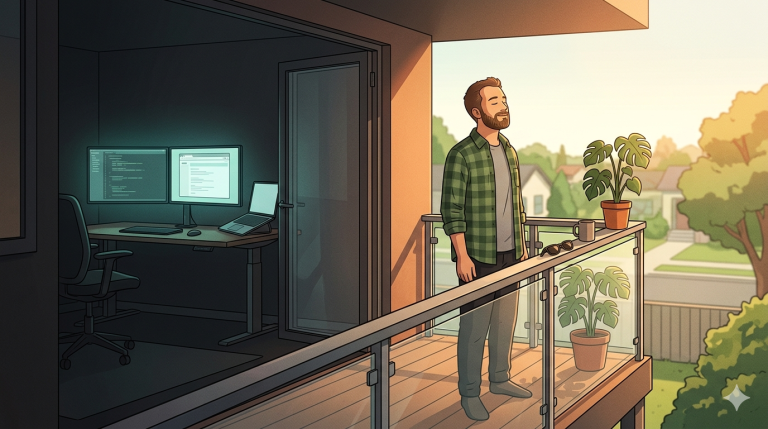
You’ve done it. The clock says 5:30 PM. You’ve closed your final tab, shut down your laptop, and stood up from your desk. Technically, you are “off work.” But as you walk into the kitchen to start dinner, your mind is still in that spreadsheet. Establishing mental boundaries remote work requires more than just a physical shutdown.
For the remote worker, the “shutdown” is often purely mechanical. Consequently, we close the lid, but we don’t close the mind. Because our work and life exist in the same physical space, our brains struggle to recognize the transition. Therefore, without a clear ritual, the office follows us into the kitchen and the living room. Actually, this “Leaky Work Syndrome” is the primary driver of high-arousal insomnia. You aren’t awake because you’re “busy.” Instead, you’re awake because your brain doesn’t think the workday has ended.
Tonight, we’re going to explore the psychology of “Boundary Theory.” Additionally, we will provide you with a tactical toolkit for an unbreakable mental shutdown ritual. Specifically, we’ll show you how to build the “psychological walls” you need. Ultimately, this ensures that when you close your laptop, you actually leave the office. Establishing these mental boundaries remote work is the secret to restorative sleep.
Your brain is a master of association. Specifically, it uses environmental cues to determine which “mode” it should be in. In a traditional office, the commute serves as a transition period. Therefore, it allows your brain to shift from “Professional Mode” to “Personal Mode.” Consequently, this is known as “Context-Dependent Memory.”
When you work from home, the cues for work are always present. Research published in the Journal of Vocational Behavior has shown that remote workers who lack clear rituals experience higher levels of cognitive interference. Your brain sees the desk and remains in a state of “low-grade alertness.” Therefore, this prevents the release of the neurotransmitters needed for relaxation. As we discussed in our guide on Work-Life Balance and Sleep, managing this transition is critical for long-term health.
To successfully disconnect, your brain requires “Cognitive Closure.” Specifically, this is the feeling that a task is resolved or safely stored. Without closure, your brain will continue to “background process” work tasks. Consequently, you use up the cognitive bandwidth you need for emotional recovery.
By creating a deliberate shutdown ritual, you are providing your brain with a series of “Done” signals. Each step acts as a neurological gate. Specifically, it closes off access to the “Work” centers of the brain. Simultaneously, it opens the “Rest” centers. Therefore, you are manually shifting your brain from a state of “Action” to a state of “Being.”
How effective is your current mental shutdown? Score yourself on a scale of 1-5 for each statement (1 = Never, 5 = Every Day).
Scoring Your Stress:
Your brain needs a physical signal that the day is over.
As we discussed in the Sunday Scaries article, the “Unfinished” is the enemy of rest.
Your phone is the primary way work “leaks” through your boundaries.
You must replace the missing physical commute with a psychological one.
Mental boundaries are built through repetition. This week, your mission is to implement the “Commute Replacement” ritual every single day. Additionally, see how it changes your ability to be “present” during dinner.
Coming Up Next: We’re concluding our month on Stress & Mental Health with Sleep and Creativity. Specifically, we’ll look at how rest is the “secret sauce” for your best work.