Physical Address
304 North Cardinal St.
Dorchester Center, MA 02124
Physical Address
304 North Cardinal St.
Dorchester Center, MA 02124
As a remote worker, your primary tool is your brain, but your primary support system is your neck. Unfortunately, the “tech-neck” posture—head tilted forward, shoulders hunched, and chin tucked—has become the professional default. This posture is a physical catastrophe. When your head is perfectly upright, it weighs about 10-12 pounds. However, for every inch you tilt your head forward to look at a monitor or a smartphone, the weight on your cervical spine doubles. At a 60-degree angle, your neck is effectively supporting a 60-pound weight—the equivalent of an average 8-year-old child sitting on your shoulders.
By the time you finish your 8-to-10 hour workday, your neck muscles (specifically the upper trapezius and levator scapulae) are in a state of chronic spasm. If you then lie down on a standard, unsupportive polyester or down pillow, you aren’t recovering; you are simply continuing the strain in a different position. A bad pillow keeps your neck in a “kinked” position, restricting blood flow and irritating the nerves that lead to your brain. This is a major cause of tension headaches, “restless brain” syndrome, and that persistent “knotted” feeling in your shoulder blades. To truly recover from a day at the desk, your pillow must provide targeted support that maintains the natural curve of your spine. You need a tool that “un-does” the damage of your workday.
In this guide, we are reviewing the best ergonomic pillows specifically designed to combat tech-neck and provide the structural support necessary for deep, restorative sleep.
Your cervical spine consists of seven small vertebrae (C1 through C7). This section of your spine is designed with a natural inward curve called a “lordosis.” This curve acts as a shock absorber for your head. When you have tech-neck, this curve flattens out, or in extreme cases, reverses (a “kyphotic” curve). This structural change puts immense pressure on the intervertebral discs and the surrounding nerves.
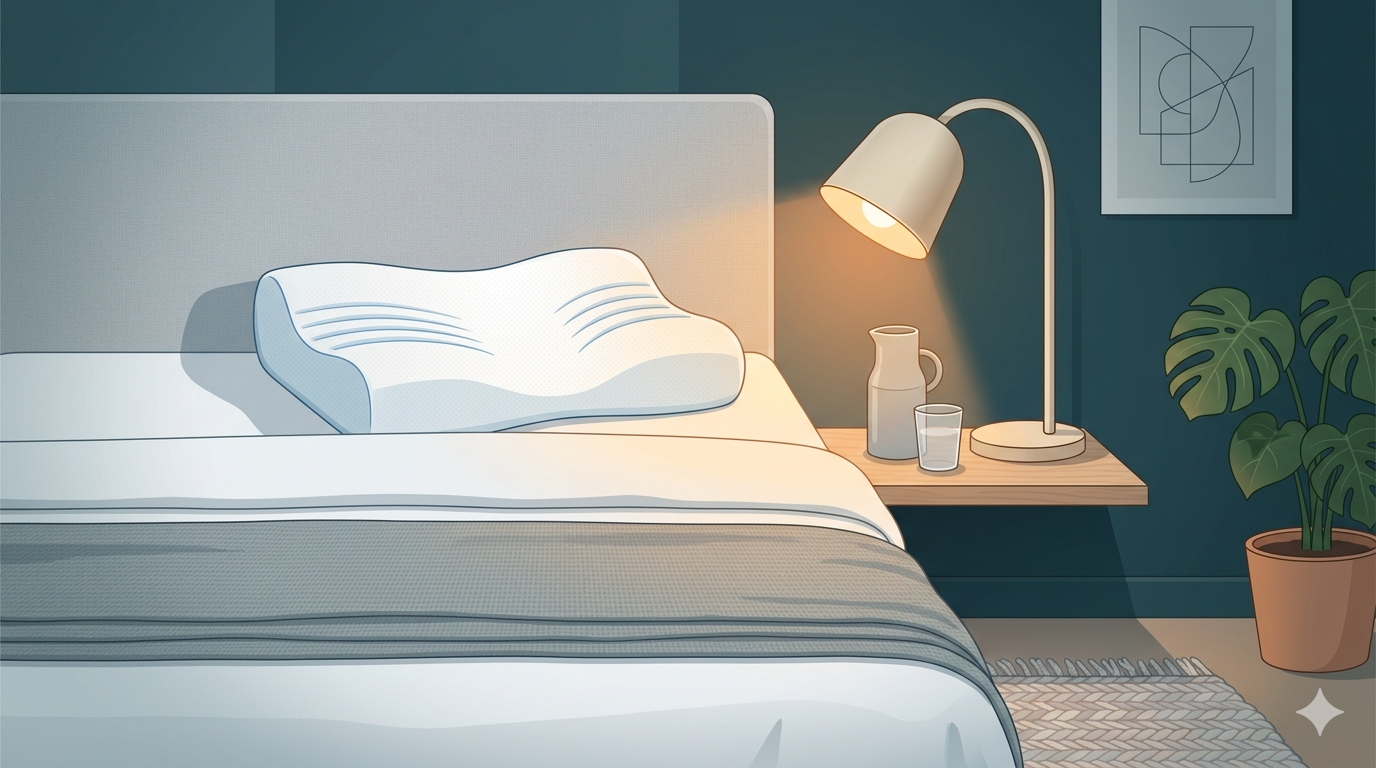
The goal of an ergonomic pillow is to maintain this lordotic curve while you sleep. For back sleepers, the pillow must fill the space between the back of your neck and the mattress without pushing your head too far forward. If the pillow is too high, it maintains the “tech-neck” angle all night long. For side sleepers, the pillow must be high enough to fill the gap between your ear and your shoulder, keeping your neck in a perfectly straight line with your thoracic spine. According to the Mayo Clinic, proper spinal alignment is essential for reducing musculoskeletal pain that disrupts sleep onset and prevents the body from entering the deeper stages of REM.
One of the biggest mistakes remote workers make is holding onto a pillow for too long. Standard pillows have a functional life of about 18 to 24 months. After this point, the structural integrity of the foam or fill begins to break down. You might not notice it, but your neck does. If you can fold your pillow in half and it doesn’t immediately spring back to its original shape, it is no longer providing the support you need. For high-performance recovery, we recommend upgrading to an ergonomic foam or polymer solution that is engineered to maintain its density for 3 to 5 years.
The Purple Harmony uses a unique “Honeycomb” Grid made of hyper-elastic polymer. Unlike memory foam, which can feel “trapping” and hot, the Purple Grid provides instant response. This is vital for the active sleeper who shifts positions throughout the night.
The Remote Work Use Case: The “High-Heat” Focused Professional
If you find that your neck pain is often accompanied by “night sweats” or a general feeling of being overheated, the Purple Harmony is your best bet. The grid structure is 90% air, meaning it doesn’t trap the heat radiating from your head. This keeps your core body temperature low, which is a key biological requirement for falling into deep sleep.
This is the original contoured pillow. It is made of high-density TEMPUR material that follows the natural curve of your body, supporting your head, neck, and shoulders. It features a “wave” design with a higher lobe for the neck and a lower recess for the head.
The Remote Work Use Case: The Chronic Pain Sufferer
If your tech-neck has progressed to the point where you wake up with regular headaches or numbness in your arms, the Tempur-Pedic is a prescriptive-grade tool. It doesn’t “coddle” you; it forces your neck into the correct anatomical position. It is the “hard labor” of sleep hygiene, but it is the most effective way to reverse years of desk-bound damage.
The Casper Foam Pillow features a unique “pillow-in-a-pillow” design. It has a supportive, high-density inner core and a soft, responsive outer layer. This provides the classic “hotel feel” while still maintaining the ergonomic integrity your cervical spine requires.
The Remote Work Use Case: The Multi-Position Sleeper
Many remote workers find they shift from back to side sleeping as they process the day’s events. The Casper Foam is the best “all-rounder” because its dual-layer construction responds to different weights and angles without needing manual adjustment. It is a massive upgrade over any traditional down or feather pillow.
| Feature | Purple Harmony | TEMPUR-Neck | Casper Foam |
|---|---|---|---|
| Material | Hyper-Elastic Polymer | High-Density Memory Foam | Dual-Layer Poly Foam |
| Cervical Contouring | Moderate | High (Elite) | Low-Moderate |
| Cooling | 10/10 | 5/10 | 8/10 |
| Support Level | Responsive/Medium | Firm/Anatomic | Medium/Plush |
| Best For | Hot Sleepers | Chronic Pain | All-Around Comfort |
If you want a pillow that feels like it was designed in a lab for your specific recovery, the Purple Harmony Pillow is our top pick. Its ability to stay cool while providing instant, “floating” support for your neck is unmatched. It feels like it “erases” the tension of a 10-hour workday the moment you lie down. It is the perfect marriage of luxury and biomechanics.
However, if you are struggling with acute cervical pain and need a more “locked-in” orthopedic feel to correct your posture, the Tempur-Pedic TEMPUR-Neck is the gold standard. It is a firmer commitment, but it is the one that physical therapists recommend most.
Choosing the right pillow is the first half of the neck recovery equation. The second half is understanding how your desk setup creates the problem in the first place. In our next guide, Alignment & Recovery, we will look at how to optimize your monitor height and chair support to reduce the load on your neck before you even hit the bedroom. For today, perform the “Pillow Fold Test.” If your pillow fails, your neck is paying the price.