Physical Address
304 North Cardinal St.
Dorchester Center, MA 02124
Physical Address
304 North Cardinal St.
Dorchester Center, MA 02124
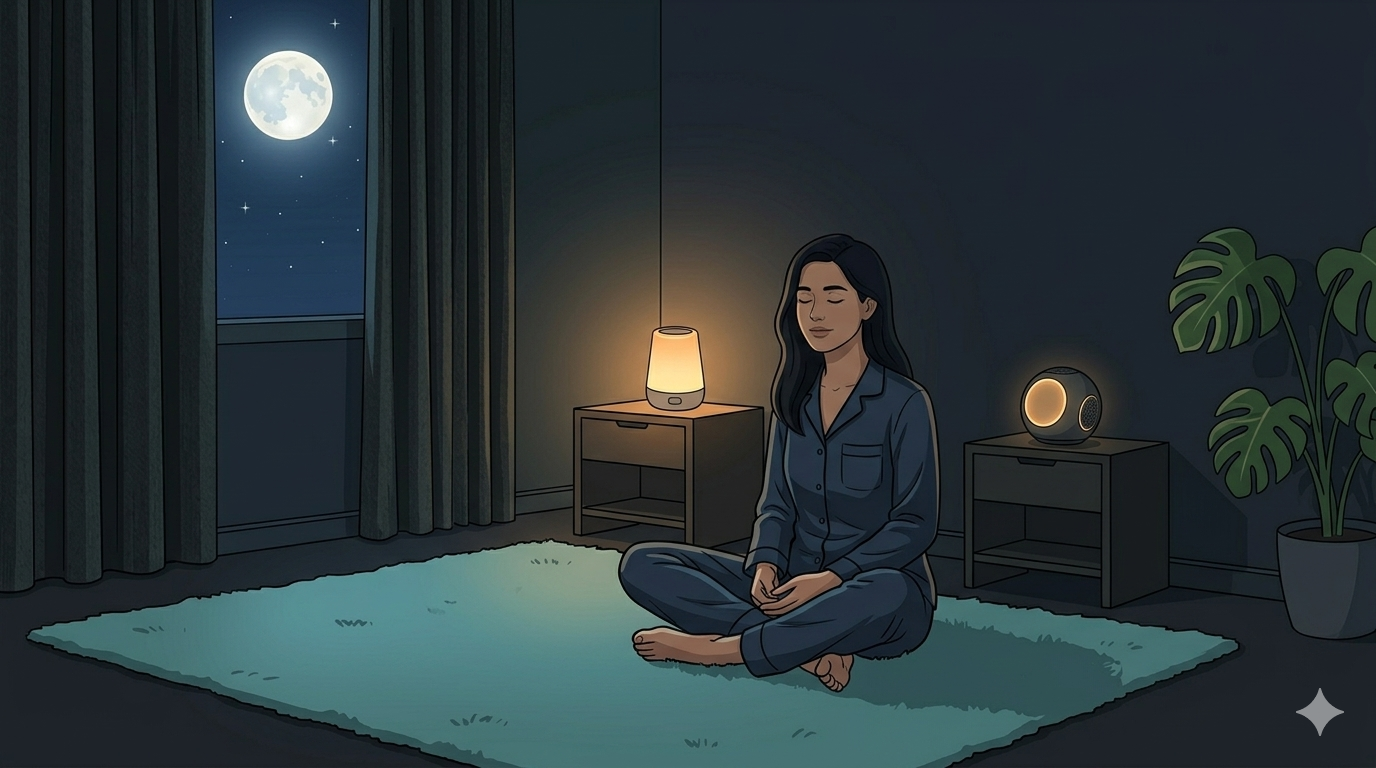
You’ve heard the advice a thousand times. “Just meditate.” You’ve seen photos of serene individuals sitting in sun-drenched rooms with their eyes closed. They look as if they haven’t a single Slack notification in the world. However, for you, the reality is different. You sit down and close your eyes. Within thirty seconds, your brain has drafted three emails. It remembered a meeting you missed in 2019. Now, it wonders if you left the oven on. Achieving meditation for sleep often feels like a distant dream when your mind is racing.
For the high-performing remote worker, meditation feels like another item on the to-do list. Consequently, you feel like you are “failing” at another task. Your entire workday involves rapid-fire information processing. Therefore, asking your brain to drop into deep silence is difficult. It is like asking a Formula 1 car to go from 200 mph to zero in half a second. Usually, you just skid and crash.
But here’s the secret: meditation isn’t about clearing your mind. Instead, it is about changing your relationship with your thoughts. For the busy remote worker, you don’t need an hour on a cushion. You need five minutes of tactical, science-backed mindfulness. This practice fits into the gaps between your meetings and your rest.
Tonight, we will dismantle the myth of the “perfect” meditation. We will provide a toolkit of 5-minute routines. These are designed to down-regulate your nervous system. Ultimately, they prepare your brain for elite-level rest.
Your brain operates in the “Default Mode Network” (DMN) when it isn’t focused on a task. This is where rumination happens. Research from Harvard University has shown that mindfulness meditation changes the structure of the DMN. Regular, short-duration practice reduces activity in areas responsible for “self-referential” thought. These are the “I” and “Me” thoughts that keep you awake at night.
By practicing just five minutes of meditation for sleep, you are training your brain. You learn to “step out” of the stream of work-related thoughts. You aren’t stopping the thoughts. Instead, you are choosing not to ride the wave. Over time, this makes it easier to disconnect from your desk. You can then transition into a sleep-ready state more effectively.
Meditation serves as a manual override for your Autonomic Nervous System. Most remote workers spend their day in “Sympathetic” mode. This is the “fight or flight” state driven by deadlines. It is characterized by high cortisol and shallow breathing.
Short, focused meditation routines stimulate the Vagus nerve. This nerve is the primary driver of the Parasympathetic Nervous System. It controls your “rest and digest” functions. When you activate the Vagus nerve, your heart rate drops. Your muscles relax. Your brain receives a signal that it is safe to sleep. As we discussed in our guide on Work-Life Balance and Sleep, managing this transition is critical for long-term health.
How prepared is your brain for a meditative transition? Score yourself on a scale of 1-5 for each statement (1 = Never, 5 = Every Day).
Scoring Your Stress:
When you are stressed, your brain “lives” in your head. The Body Scan pulls your attention back into the physical world. This is a powerful signal for relaxation.
This is the antidote to rumination. Instead of fighting your work thoughts, you are going to categorize them.
We advocate for a digital-free bedroom. However, we also recognize the power of guided tools for those struggling with silence.
If you can only do one thing, do this. It is the most efficient way to down-regulate your nervous system.
You might wonder if five minutes is really enough. Initially, it may feel too short to make a difference. However, research suggests that frequency is more important than duration. Practicing daily for five minutes is better than one hour once a week. This is because you are building a habit of “down-shifting.”
Furthermore, shorter sessions are easier to maintain during busy weeks. If you have a deadline, you can still find five minutes. Consequently, you maintain your progress even during high-stress periods. This consistency strengthens the neural pathways associated with relaxation. Eventually, your brain will automatically begin to relax when you start your routine.
Additionally, you can integrate these micro-meditations into your workday. For instance, try a one-minute box breath between meetings. This prevents stress from accumulating throughout the day. Therefore, by the time you reach your evening routine, your “stress baseline” is much lower.
Mindfulness is a muscle. This week, your mission is to implement the “Body Scan Reset”. Do this as soon as your head hits the pillow. Observe if it reduces your time to fall asleep.
Coming Up Next: We’re exploring the power of the written word. We will look at Journaling for Sleep. We will show you how to “dump” your work stress onto paper.