Physical Address
304 North Cardinal St.
Dorchester Center, MA 02124
Physical Address
304 North Cardinal St.
Dorchester Center, MA 02124
The sun has long since set, but your home office is still buzzing with the blue light of your dual monitors. You just finished a late-night sprint to meet a deadline, and suddenly, you realize you haven’t eaten a real meal since 1:00 PM. Your stomach is growling, and the convenience of your kitchen is calling. You whip up a quick late-night pasta or grab a heavy sandwich, eat it while scrolling through your final emails, and then head straight to bed. An hour later, you are still staring at the ceiling, feeling “wired but tired,” with a subtle heat radiating from your midsection.
For the remote worker, the traditional “9-to-5” lunch hour has vanished, replaced by a chaotic grazing schedule or a “starve-then-stuff” cycle. We often think of our circadian rhythm as something controlled only by light, but your digestive system has its own internal clock. When these two clocks are out of sync—a phenomenon known as “circadian misalignment”—your sleep quality suffers, even if you are getting eight hours of shut-eye. The timing of your meals acts as a powerful “zeitgeber,” or time-giver, that tells your body when to be active and when to rest.
Every cell in your body has a clock. While the “master clock” in your brain (the suprachiasmatic nucleus) is primarily regulated by light, the clocks in your liver, gut, and pancreas are heavily influenced by nutrient intake. These are called “peripheral oscillators.” When you eat at inconsistent times or very late at night, you send conflicting signals to your body. Your brain says “it’s night,” but your liver says “it’s noon.”
Research from the Salk Institute for Biological Studies, led by pioneers like Dr. Satchin Panda, has shown that “time-restricted feeding” can significantly improve metabolic health and sleep quality. By confining your eating to a specific window, you allow your body’s repair mechanisms to activate fully during the night. If your digestive system is constantly processing food, it cannot focus on the cellular cleanup and hormonal regulation that are supposed to happen while you sleep.
To fall into a deep sleep, your core body temperature needs to drop by about two to three degrees Fahrenheit. This drop is a signal to your brain that it is time to release melatonin and enter the recovery phase. However, digestion is a metabolic process that generates heat—a phenomenon known as the “thermic effect of food.” If you consume a large meal close to bedtime, your body remains “warm” as it works to break down those calories.
This internal heat spike can prevent you from reaching the lower temperatures required for Stage 3 Deep Sleep. You might find yourself tossing and turning, or waking up feeling “sweaty” or restless. For remote workers who spend most of their day in a climate-controlled home, this internal temperature regulation becomes even more critical. Your meal timing is essentially a “thermostat” for your nocturnal recovery, and you want that thermostat to be set to “cool” by the time your head hits the pillow.
Eating triggers the release of insulin, which is essential for managing blood sugar. However, insulin and melatonin have an antagonistic relationship. High levels of insulin can suppress the production of melatonin. If you are eating sugary or high-carb snacks late into the evening, you are effectively putting the “brakes” on your natural sleep-induction system. You might feel a temporary “food coma,” but it won’t translate into high-quality, restorative sleep.
Furthermore, late-night eating can cause a spike in cortisol, the stress hormone, as your body manages the blood sugar fluctuation. This is why you might wake up at 3:00 AM feeling alert or anxious after a late-night feast. By shifting your largest meals earlier in the day, you allow your insulin levels to stabilize long before you need your melatonin levels to peak. This creates a smooth hormonal transition from “work mode” to “sleep mode.”
Are your eating habits in sync with your internal clock? Rate yourself on a scale of 1 to 5 (1 = Never, 5 = Always).
Total Your Score:
The most impactful change any remote worker can make is the “Three-Hour Buffer Rule.” This means finishing your last bite of food at least 180 minutes before your head hits the pillow. This window allows for the majority of the thermic effect of food to dissipate and for your insulin levels to return to baseline. It ensures that when you enter the first sleep cycle, your body is ready for repair, not digestion.
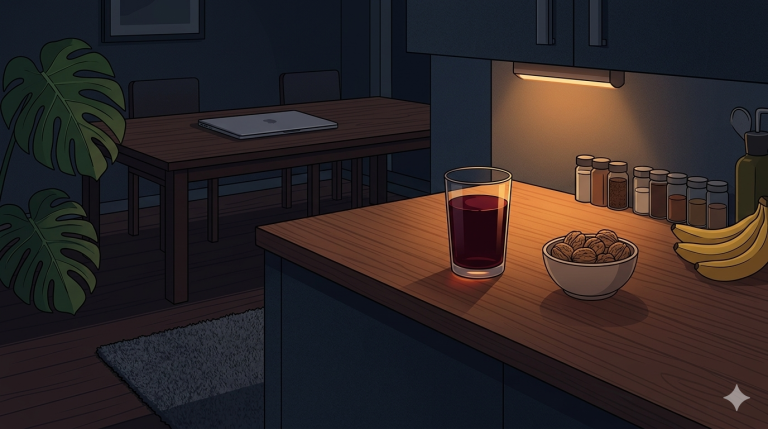
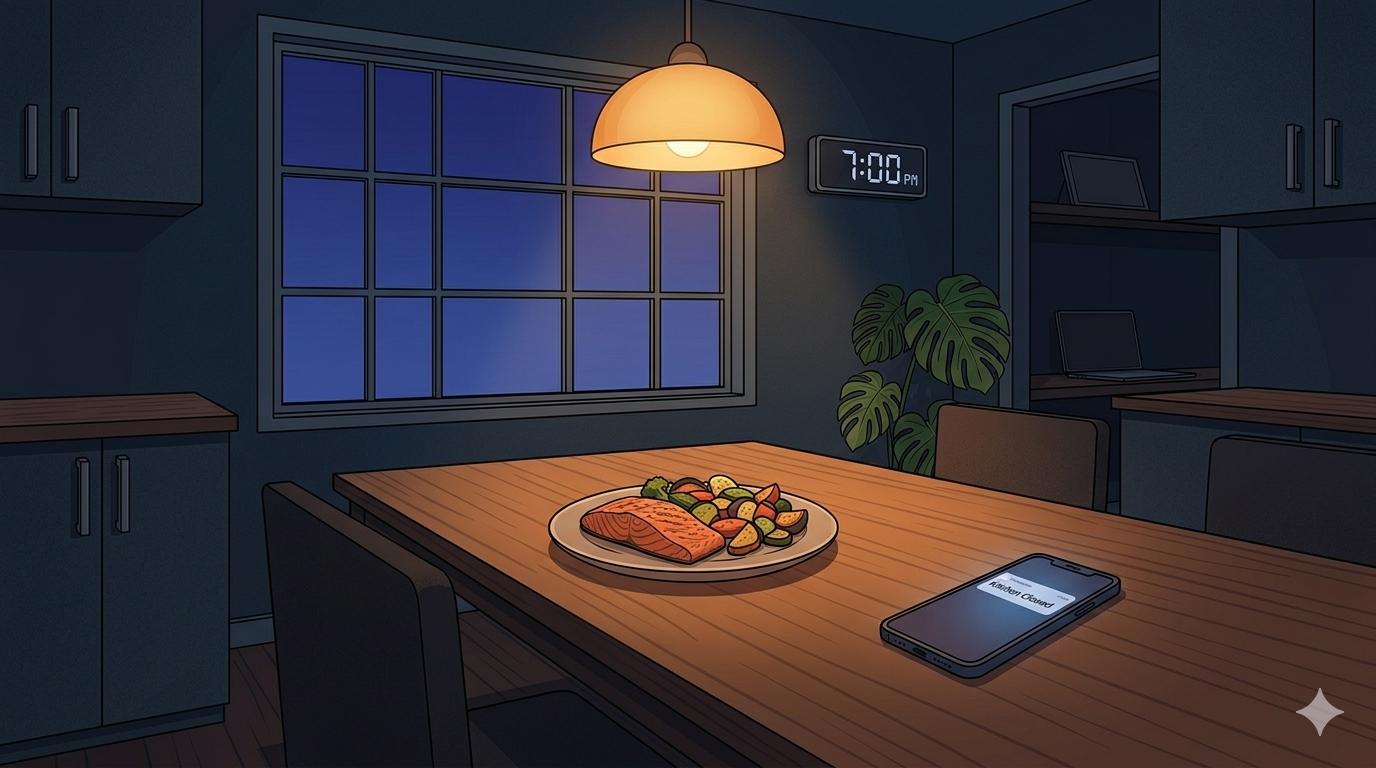
If your workday bleeds into the evening, it is better to have a smaller, easily digestible snack at 7:00 PM than a massive meal at 9:00 PM. Think of your evening meal as a “closing ceremony” for your digestive system. Once that ceremony is over, the kitchen is closed. This discipline creates a clear boundary between the “active” phase of your day and the “restorative” phase.
Just as you need a “morning routine” to start your work, your metabolism needs an “anchor” to start its day. Consuming a protein-rich breakfast shortly after waking signals to your peripheral clocks that the day has begun. This helps regulate your appetite hormones—leptin and ghrelin—throughout the day. For remote workers, it is easy to skip breakfast and survive on coffee until noon, but this often leads to overeating in the evening.
By “front-loading” your calories, you provide your brain with the steady energy it needs for those high-focus morning tasks. It also prevents the “blood sugar roller coaster” that leads to afternoon crashes and late-night cravings. An anchored morning leads to a stabilized evening, making it much easier to stick to your sleep-supportive rituals.
In many cultures, the largest meal of the day is consumed at midday. For the remote worker, this is a brilliant tactical move. Your metabolic rate is generally higher in the afternoon, and you have several hours of activity ahead to utilize those calories. A substantial lunch provides the sustained energy needed to avoid the 3:00 PM slump without the need for excessive caffeine.
When you make lunch your primary meal, your dinner can be lighter and more focused on “pre-sleep” nutrients. This shift reduces the burden on your digestive system in the evening. You will likely find that your “Time to Sleep” decreases and your morning alertness increases simply by shifting your caloric center of gravity toward the middle of the day.
Your body craves predictability. Eating at roughly the same times every day helps “entrain” your circadian rhythm. When your body knows when food is coming, it can prepare the necessary enzymes and hormones in advance. This lead-time makes digestion more efficient and less disruptive to your other biological processes.
For remote workers with erratic schedules, this consistency can be a challenge. However, even a 30-minute window of consistency is better than total randomness. Treat your meal times with the same respect you treat a client meeting. Put them on your calendar. This not only protects your sleep but also provides much-needed structure to the “borderless” world of working from home.
In our next article, we will explore the often-overlooked “liquid” side of the equation. It turns out that what and when you drink can be the final piece of the puzzle in achieving elite-level rest. We’ll dive into the water-sleep connection and how to stay hydrated without spending half the night in the bathroom.
If you are interested in the foods themselves, check out our previous guide on The Remote Worker’s Sleep Diet to ensure you are fueling with the right nutrients at these optimal times.