Physical Address
304 North Cardinal St.
Dorchester Center, MA 02124
Physical Address
304 North Cardinal St.
Dorchester Center, MA 02124
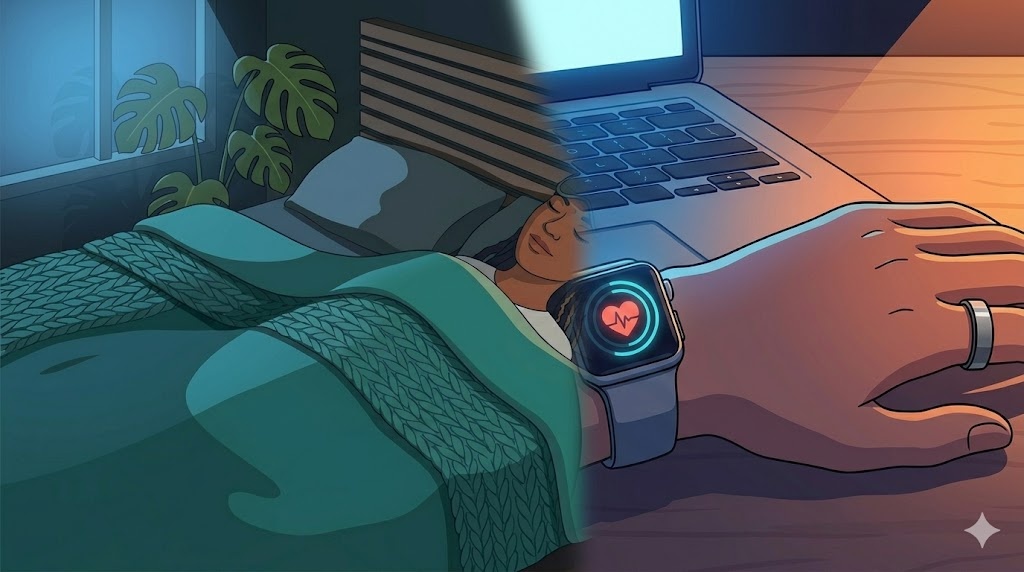
You’ve been there. It’s 9:00 AM on a Tuesday. You’ve just finished your third cup of coffee, and your Slack notifications are already starting to pile up like a digital landslide. You look at your phone. You “slept” for eight hours. You were in bed by 11:00 PM and didn’t look at a screen (mostly) after 10:30 PM. So why does your brain feel like it’s been stuffed with damp wool? Why is the simple task of responding to an email feeling like a Herculean effort?
For the modern remote worker, the “8-hour rule” has become a cruel joke. We live in a world of quantifiable output—we know our lines of code, our open tickets, and our meeting minutes—yet the most critical metric of our biological performance remains a total mystery. We treat sleep like a black box: we go in, we come out, and we hope for the best.
This is the “Sleep Data Paradox.” In an era where we can track a package across the Atlantic in real-time, most remote workers are still guessing about the quality of their rest. We wake up tired, blame the coffee, and repeat the cycle. But here’s the uncomfortable truth: If you aren’t measuring it, you can’t manage it.
But as you browse the app store or scroll through tech reviews, you’re hit with a wall of choices. Do you download that free app that records your snoring? Do you drop $300 on a sleek titanium ring? Or do you shell out thousands for a “smart” mattress that promises to chill your blood to the perfect temperature? The gap between “free” and “premium” has never been wider, and for the remote worker trying to optimize their home-office life, the wrong choice doesn’t just cost money—it costs cognitive bandwidth.
Tonight, we’re tearing down the wall. We’re going to look at what actually matters in sleep monitoring, from the “invisible” free apps to the high-end wearables, to see which ones actually help you perform better at your desk tomorrow.
In a clinical setting, sleep is measured via Polysomnography (PSG). This involves being hooked up to an EEG (brain waves), EOG (eye movements), and EMG (muscle activity). It’s the gold standard, but let’s be honest: nobody wants to sleep in a lab with wires glued to their scalp just to see if their afternoon espresso was a mistake.
Consumer sleep trackers use Actigraphy—the measurement of movement. Free phone apps use your phone’s accelerometer (if placed on the mattress) or microphone to “guess” your sleep stages based on how much you toss and turn. While these aren’t as accurate as brain-wave monitoring, they provide a vital baseline for remote workers to identify patterns over time. The goal isn’t clinical perfection; it’s directional accuracy.
The real “secret sauce” of paid monitors—like the Oura Ring or the Apple Watch 9—is Heart Rate Variability. HRV is the millisecond-level variation between your heartbeats. It is a direct window into your Autonomic Nervous System.
When your HRV is high, your body is recovered and ready for high-intensity work. When it’s low, your nervous system is stuck in “fight or flight” mode (often due to that late-night Slack message from your boss). Free apps rarely have access to this level of biometric data, which is the primary reason why paid “hardware” solutions often provide a more actionable “Readiness” score for your workday.
How much do you actually know about your nocturnal performance? Score yourself on a scale of 1-5 for each statement (1 = Never, 5 = Every Day).
Scoring Your Rest:
The best monitor is the one you actually use. Free apps like Sleep Cycle require you to place your phone on the bed or nightstand. This introduces “friction”—you have to remember to start the app. Wearables like the Fitbit Sense 2 or the Garmin Vivosmart 5 are “set it and forget it.” For the busy remote worker, reducing the number of steps to get data is the key to long-term success.
Avoid “data-jumping.” Many remote workers try a tracker for two nights, see a “bad” score, get stressed, and stop. You need a minimum of 14 days of data to establish a biological baseline. Only then can you accurately see how your Tuesday “all-hands” meeting affects your Wednesday morning focus.
If you use a phone-based tracker, you are bringing a light-emitting device into your sleep sanctuary. To optimize this, ensure your phone is in “Sleep Mode” or “Do Not Disturb” and use the “Digital Sunset” protocol: no interacting with the screen for at least 30 minutes before the app begins tracking.
Orthosomnia is the clinical term for the anxiety caused by a “bad” sleep score. If waking up and seeing a 65/100 readiness score makes you feel more stressed than the actual lack of sleep, you need to recalibrate. Data is a tool, not a judge. If your monitor is causing more stress than it’s solving, switch to a “passive” tracker that you only check once a week.
Monitoring is just the first step. Data without action is just noise. Your mission for the next week is to find your “One Variable.” Is it the temperature? Is it the 3:00 PM coffee? Use your data to find the one thing that ruins your night.
Coming Up Next: We’re moving from measuring to managing as we dive into Month 4: Stress & Mental Health, where we’ll tackle the “Work-Life Balance” crisis that keeps your brain on high alert long after you’ve clocked out.