Physical Address
304 North Cardinal St.
Dorchester Center, MA 02124
Physical Address
304 North Cardinal St.
Dorchester Center, MA 02124
In the modern quest for a perfect night’s rest, we have been conditioned to believe that sleep is something we must purchase rather than something we must permit. If you’ve spent any time scrolling through social media or browsing late-night television, you’ve seen the narrative: a $5,000 “smart” mattress that tracks your tossing and turning, $800 sheets woven from the silk of rare high-altitude caterpillars, and bedside gadgets that look more like NASA control panels than alarm clocks. The mattress industry, in particular, has mastered the art of “The Marketing of Sleep.” They sell us the dream of a cloud-like experience, suggesting that if we just find the right density of memory foam or the perfect number of pocketed coils, our chronic exhaustion will vanish overnight.
But here is the uncomfortable truth that the “Big Sleep” industry doesn’t want you to hear: a $5,000 mattress is often just a very expensive distraction from a fundamentally broken environment. You can lie on the most technologically advanced slab of foam in the world, but if your bedroom is 74 degrees, flooded with the blue light of a streetlamp, and buzzing with the low-frequency hum of your refrigerator, your brain will remain in a state of high alert. As remote workers, we are particularly susceptible to this marketing trap. We feel the “studio apartment struggle” acutely—our desks are often less than three feet from our pillows, blurring the lines between the “War Room” where we fight for our careers and the “Sanctuary” where we are supposed to recover. We feel that if we just throw money at the problem, we can buy back the boundaries that working from home has dissolved.
The reality is that sleep optimization is less about what you add to your room and more about how you control the biology of your space. Your bedroom isn’t just a place to store your body between Zoom calls; it is the “Battery Charging Station” for a career that is likely worth hundreds of thousands, if not millions, of dollars over your lifetime. If you were managing a data center or a high-performance laboratory, you wouldn’t just buy a fancy chair and ignore the cooling systems, the light levels, or the structural integrity of the room. You would optimize for the hardware. Your brain is the most expensive piece of hardware you own. It’s time we stopped looking for a magic purchase and started looking at the thermal biology and psychological triggers that actually dictate whether we wake up ready to crush the day or merely survive it.
To understand why a budget-friendly DIY approach often outperforms a “luxury” purchase, we have to look at the hard science of sleep. Let’s start with Thermoregulation on a Budget. Your body’s internal temperature follows a circadian rhythm, peaking in the late afternoon and reaching its lowest point in the early hours of the morning. For you to fall asleep, your core body temperature must drop by about 2 to 3 degrees Fahrenheit. This is non-negotiable biology. If your environment is too warm, your body has to work overtime to shed heat, pumping blood to the extremities and keeping your heart rate elevated. This “thermal stress” keeps you in lighter stages of sleep, denying you the deep, restorative N3 sleep where your brain literally “washes” itself of metabolic waste. High-end cooling mattresses try to solve this with active water-cooled layers, but you can achieve 80% of the same result by mastering airflow physics and fabric selection for a fraction of the cost.
Then, there is The Decibel Threshold of the WFH Mind. For the remote worker, the home is no longer a silent retreat. It is a place of neighborly leaf-blowers, barking dogs, and the internal “echo” of a day spent in digital meetings. Scientific research suggests that it isn’t necessarily the volume of a sound that wakes you, but the change in sound. This is known as the “Startle Response.” If your room is pin-drop silent and a car door slams outside, your brain interprets that sudden spike in decibels as a threat. However, if you have a consistent, broadband “masking” sound—like white or pink noise—it raises the “noise floor” of the room. This makes the car door slam statistically insignificant to your auditory cortex. By understanding how to mask the neighborhood effectively, you aren’t just blocking noise; you are providing your nervous system with a “blanket of safety” that allows it to disengage from the environment.
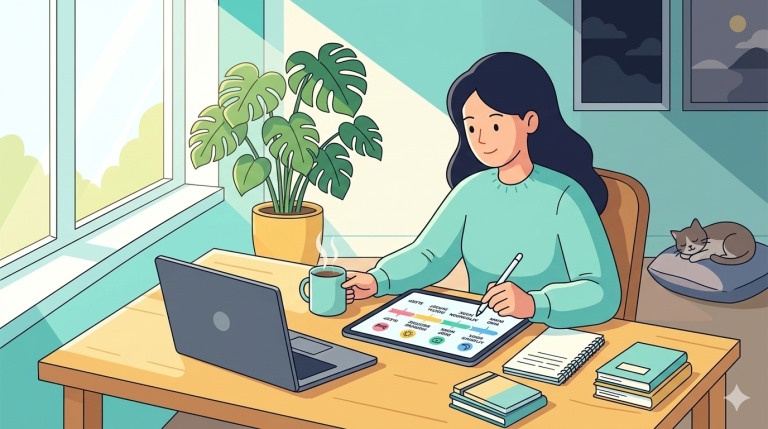
Before you spend a single dollar, you need to know where your “leaks” are. Take ten minutes tonight—at the exact time you usually go to bed—and perform this audit. Rate each category from 1 (Total Disaster) to 5 (Laboratory Grade).
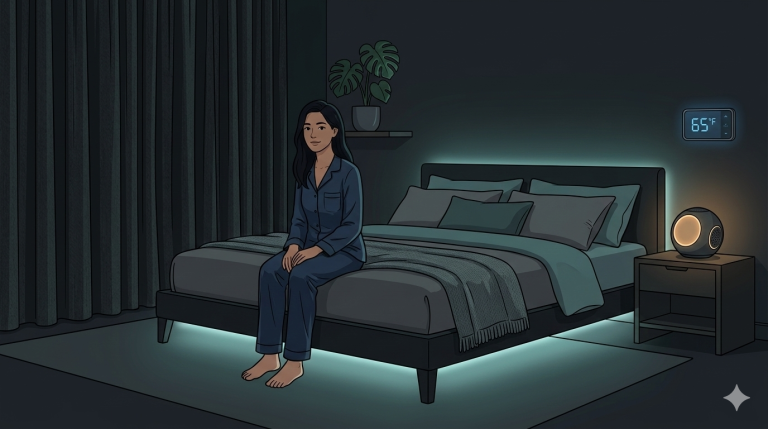
We live in a world of “Light Pollution,” and for the remote worker in a studio or a small apartment, the struggle is real. You might have a desk lamp that stays on late or a router that blinks like a miniature disco in the corner. The goal of the Blackout Protocol is to achieve “Total Darkness” without needing to hire a contractor to install motorized shutters.
First, let’s talk about the windows. If you can’t afford custom blackout shades, NICETOWN Blackout Curtains are the gold standard for budget-conscious sleepers. They provide a heavy, triple-weave fabric that blocks 99% of light and even provides a small amount of thermal insulation. However, the secret “pro move” is the Cardboard and Tape Hack. If you have a window that lets light in through the sides of your curtains, take a piece of black foam board or even standard cardboard, cut it to the size of the window frame, and use painters’ tape to secure it. It’s not “Instagram-pretty,” but it creates a literal vault of darkness.
Next, audit your internal lights. Use small squares of black electrical tape to cover the “power” LEDs on your monitor, your air purifier, and your power strips. If you have a gap under your bedroom door that lets light in from the hallway, a rolled-up towel (the classic “Draft Dodger”) is a $0 solution that works perfectly. Remember: your skin actually has photoreceptors. Even if your eyes are closed, your body knows when the lights are on.
For those of us working from home, the world doesn’t stop just because we need to sleep. Your neighbor’s 6 AM commute or the mid-afternoon lawn service can ruin a sleep cycle. Instead of trying to “block” the sound (which requires expensive construction), we “mask” it.
The most effective tool for this is a mechanical white noise machine. While phone apps are a great start, the speakers on a smartphone often lack the depth and frequency range to mask low-frequency sounds like truck engines. The Marpac Dohm Classic is a cult favorite for a reason: it uses a real internal fan to create a natural, soothing rush of air. It’s a “buy once, use for a decade” investment.
If you are on a strict $0 budget, look into “Brown Noise” on YouTube or Spotify. Unlike white noise (which can be “hissy”), Brown noise has more bass, which is much better at masking the thuds and bumps of a busy apartment building. If you have a particularly loud environment, don’t be afraid to double up: use a white noise machine near the window and wear a pair of high-quality Earplugs to create a final layer of defense.
As we discussed, you need to drop your core temperature. If you can’t afford an $800 cooling topper, you must become a master of “Passive Cooling.” This starts with the Airflow Physics of your room. If you have a window, use the “Two-Fan Cross-Breeze” technique. Place one fan in the window blowing in and another fan on the opposite side of the room blowing out. This creates a constant cycle of fresh, cool air and prevents the buildup of humid “body heat” around your bed.
Fabric choice is your next line of defense. Get rid of polyester or “microfiber” sheets. Polyester is essentially plastic; it traps heat and moisture against your skin. Switch to 100% cotton or bamboo. Even a cheap set of high-thread-count cotton sheets from a discount store will breathe better than the most expensive “performance” synthetic sheets.
Finally, consider the “Hot Water Bottle” Reverse Hack. Fill a hot water bottle with cold water and place it in the freezer for an hour before bed. Tuck it between your sheets near your feet. Because your feet are one of the primary “heat exchangers” for your body, cooling them down will trigger a rapid drop in your core temperature, signaling to your brain that it is time to shut down.
This is the most critical pillar for the remote worker. When your bedroom is also your office, your brain begins to associate the bed with the stress of emails and deadlines. We need to create a “Third Space”—a psychological boundary that separates “Work” from “Rest.”
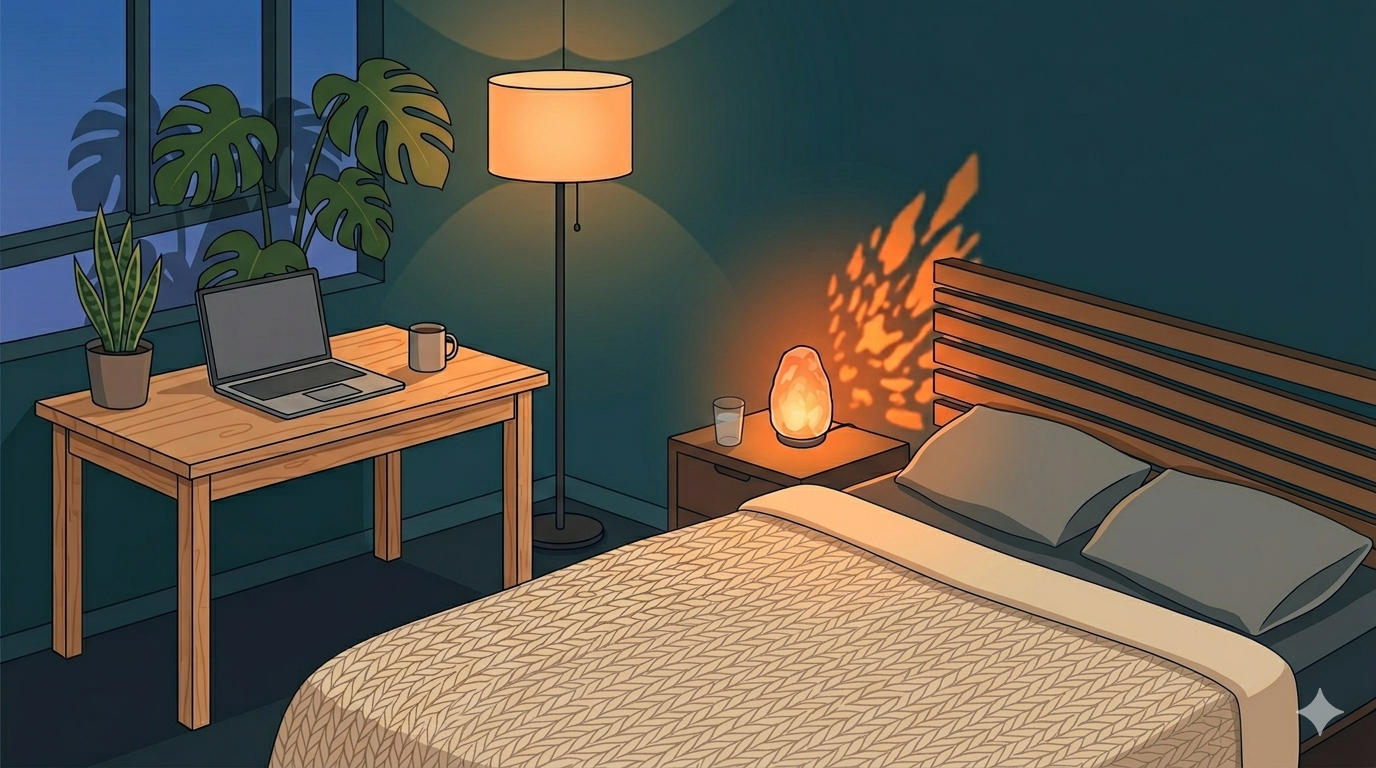
You don’t need a separate room to do this. You need Visual Cues. If your desk is in your bedroom, use a physical barrier. A simple folding screen, or even a strategically placed tall plant (like a Monstera), can hide your workspace from view when you are in bed. If you can see your laptop, your brain is “on.”
Use Lighting to Partition. During the day, use bright, “cool” white light to signal productivity. At 7 PM, switch everything. Use a small salt lamp or a warm-toned floor lamp to create an “Amber Glow.” This shift in color temperature tells your pineal gland to start producing melatonin. Adding an URPOWER Essential Oil Diffuser with lavender or cedarwood creates an “Olfactory Anchor.” After a week of doing this, the smell of the oil and the change in light will automatically trigger a relaxation response, regardless of how stressful your workday was.
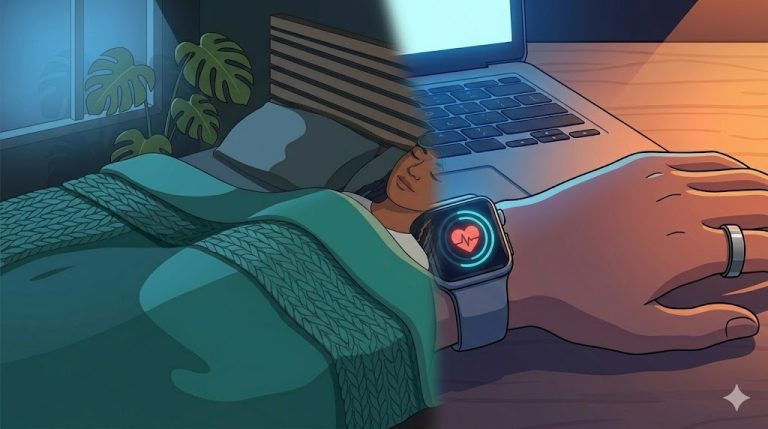
Optimizing your environment is the foundation, but how do you know if it’s actually working? Next week, we’re going to dive into Sleep Quality Monitoring. We’ll look at how to use the data from your wearables to “A/B Test” your environment changes. Did the “Blackout Protocol” increase your Deep Sleep by 15%? Did the “Passive Cooling” lower your resting heart rate? We’ll show you how to read the data like a pro.
Until then, remember: your bedroom is your sanctuary. It’s the place where the “Work-From-Home You” turns back into the “Human You.” Treat it with the respect your biology deserves.