Physical Address
304 North Cardinal St.
Dorchester Center, MA 02124
Physical Address
304 North Cardinal St.
Dorchester Center, MA 02124
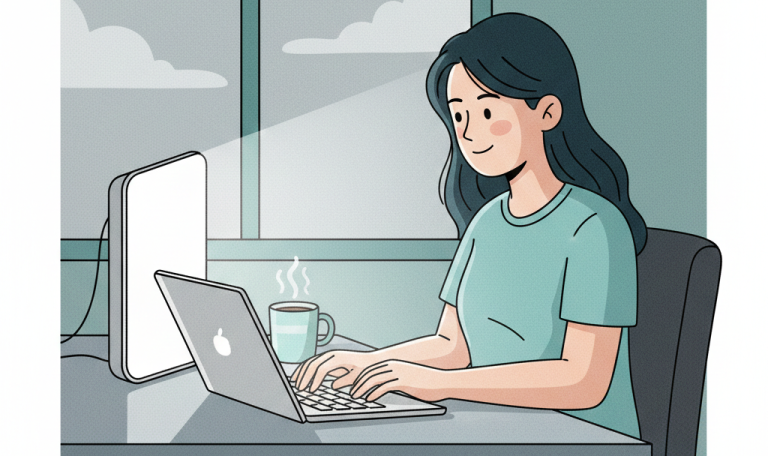
For many remote workers, the day starts with the comforting ritual of coffee. That first sip of caffeine signals “work mode activated,” boosting focus and energy. But that morning cup – and every subsequent one – has a powerful effect that extends far beyond your last email. The timing of your caffeine intake is a critical, yet often overlooked, factor in your sleep quality.
I’ve seen countless remote professionals unknowingly sabotage their sleep with poorly timed caffeine. It’s not about quitting coffee entirely, but understanding how this powerful stimulant interacts with your body’s natural rhythms to ensure it enhances, rather than hinders, your sleep and, by extension, your productivity.
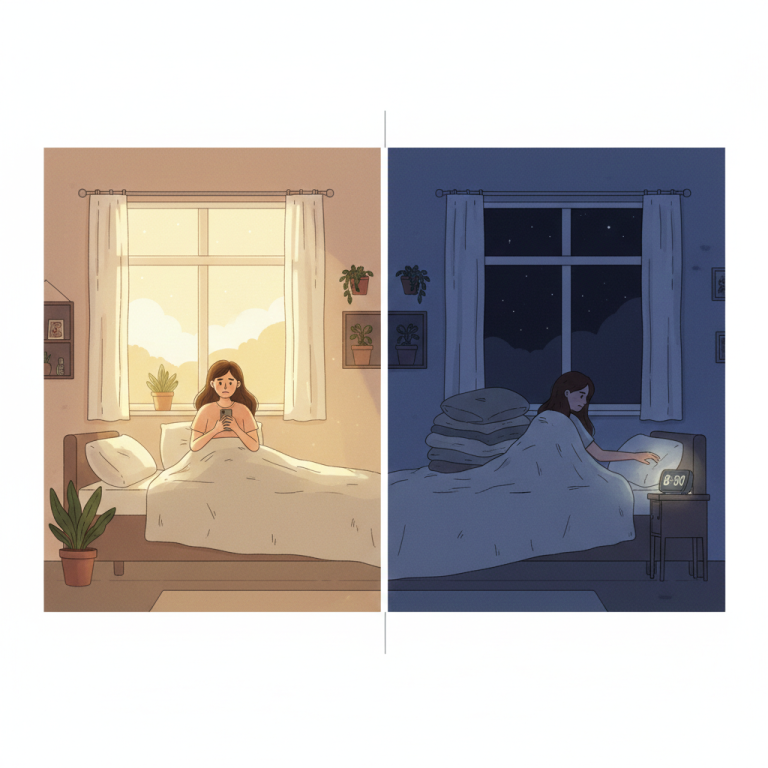
Picture this: It’s 3 PM, and you’re staring at your laptop screen, feeling that familiar afternoon energy dip. Your next meeting is in an hour, and you need to be sharp. You reach for that trusty coffee mug, thinking you’re making the smart choice to power through. But here’s what you don’t realize – that seemingly innocent afternoon cup is setting you up for a restless night, which leads to grogginess tomorrow, which leads to… you guessed it, more afternoon coffee.
You’re not alone in this cycle. Remote workers face unique challenges when it comes to caffeine timing. Without the natural boundaries of a traditional office environment, many find themselves reaching for their fourth or fifth cup well into the evening hours. The lines between work and personal time blur, and caffeine becomes both a productivity tool and a sleep saboteur.
Let’s get clear on what’s actually happening in your body when you drink that cup of joe. Caffeine primarily works by blocking adenosine, a neurotransmitter that builds up throughout the day and makes you feel sleepy. When adenosine is blocked, you feel alert. The problem? Caffeine has a surprisingly long half-life.
Caffeine’s Half-Life: The half-life of caffeine is typically 3 to 5 hours, meaning that’s how long it takes for your body to eliminate half of the caffeine you consumed. If you have a cup of coffee at 3 PM, by 8 PM, half of that caffeine is still in your system. By 1 AM, a quarter of it remains! This isn’t just theory – sleep studies consistently show that caffeine consumed even six hours before bedtime can significantly reduce sleep quality.
The Remote Work Trap: Without a commute to signal the end of the workday, remote workers often extend their “work hours” and, consequently, their caffeine consumption into the late afternoon or evening to maintain focus. This late-day caffeine lingers, making it difficult for your body to naturally wind down.
Sleep Quality vs. Sleep Quantity: Even if you manage to fall asleep with caffeine in your system, your sleep quality suffers. Caffeine fragments sleep, particularly the crucial deep sleep (slow-wave sleep) and REM sleep stages, leaving you feeling less rested and more groggy the next day.
Here’s the kicker: you might not even realize caffeine is affecting your sleep. Many people report being able to “drink coffee and fall asleep just fine,” but research shows that caffeine can reduce sleep efficiency and increase the time spent in lighter sleep stages, even when you’re not consciously aware of it.
Let me guess – you’ve probably tried to “manage” your caffeine intake before. Maybe you switched to “half-caff” in the afternoon, or you told yourself you’d stop at 2 PM but found yourself brewing another cup at 4 PM “just this once.” If this sounds familiar, you’re not failing – you’re just missing some key pieces of the puzzle.
The traditional advice of “no caffeine after 2 PM” is a good starting point, but it’s not personalized to your unique biology or work schedule. Some people are genetically fast metabolizers of caffeine and can handle it later in the day, while others are slow metabolizers who need to cut off much earlier. Plus, as a remote worker, your schedule might not align with conventional wisdom.
The goal isn’t to eliminate caffeine – it’s to use it strategically to maximize its benefits without sacrificing your sleep. Think of caffeine as a tool in your productivity toolkit, not a crutch you lean on throughout the day.
For most people, the ideal caffeine cut-off time is 8 to 10 hours before your desired bedtime. If you aim to be asleep by 10 PM, your last coffee or caffeinated tea should be no later than 12 PM (noon). If you’re sensitive to caffeine, aim for even earlier.
Why this works: This allows your body sufficient time to metabolize the caffeine, ensuring adenosine can build up naturally, paving the way for smooth sleep onset.
But here’s where it gets personal – you need to understand your own caffeine sensitivity.
Genetic factors play a role in how quickly you metabolize caffeine. Some individuals are “fast metabolizers” and can handle later consumption, while “slow metabolizers” need to cut off caffeine much earlier. The only way to know which category you fall into is to pay attention to how late-day caffeine affects you.
Self-Assessment Test: Try cutting off caffeine by noon for one full week. Notice if your sleep quality improves – specifically, how quickly you fall asleep, how often you wake up during the night, and how rested you feel in the morning. If you see significant improvement, you’re likely a slow metabolizer. If you don’t notice much difference, you might be able to push your cut-off time to 2 PM and test again.
Caffeine is a diuretic, meaning it can increase urine production and contribute to dehydration. Dehydration, even mild dehydration, can impact both your cognitive performance and your sleep quality. Make sure you’re drinking plenty of water throughout the day to stay hydrated.
Practical tip: For every cup of coffee you drink, aim to drink an equal amount of water. Keep a reusable water bottle at your desk and set hourly reminders to take a few sips.
Tool Tip: A Hydro Flask [affiliate link] or Stanley Quencher [affiliate link] can help you track your water intake throughout your workday. The visual reminder of seeing your water level drop encourages consistent hydration.
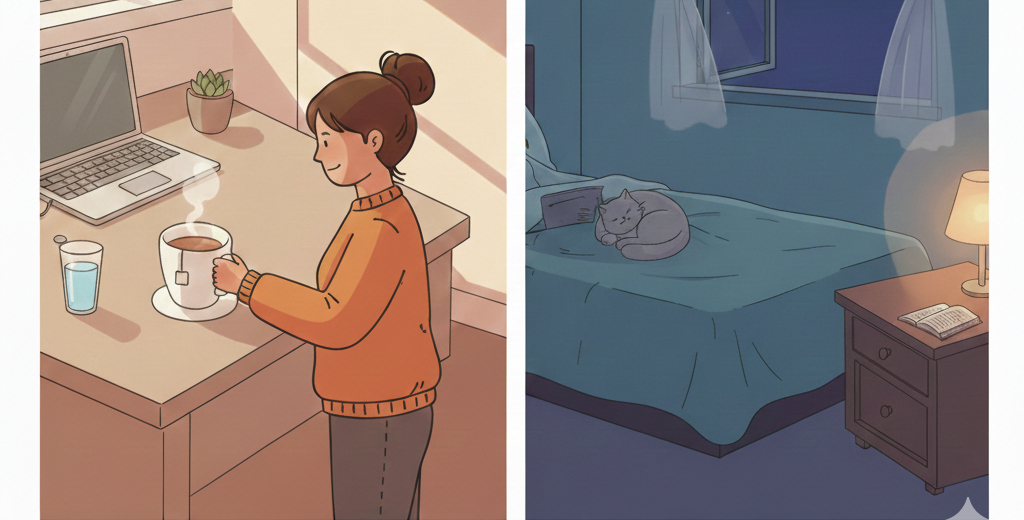
If you crave a warm beverage in the afternoon or evening, you don’t have to go cold turkey. Switch to decaffeinated coffee or herbal teas that can satisfy the ritual without the stimulant.
Product Recommendation: Brands like Celestial Seasonings Sleepytime Tea [affiliate link] or various decaf coffee options [affiliate link] can satisfy the ritual without the stimulant. Many people find that the act of brewing and sipping a warm beverage provides much of the comfort they associate with their coffee routine.
Instead of relying on caffeine for afternoon energy, consider these natural alternatives:
These strategies can provide an energy boost without interfering with your sleep later.
Ready to transform your caffeine strategy? Here’s your step-by-step plan:
Week 1 – Track Your Baseline:
Week 2 – Identify Your Sweet Spot:
Week 3 – Make the Switch:
Week 4 – Fine-Tune and Solidify:
Strategic caffeine use can be a remote worker’s ally, but uncontrolled consumption is a stealthy enemy of your sleep. The beauty of working from home is that you have complete control over your environment and schedule – use this to your advantage.
Remember, this isn’t about perfection. There will be days when you need that 3 PM coffee to get through an important presentation. The goal is to make mindful choices most of the time, understanding the trade-offs involved.
Shift your caffeine habits, and you’ll soon experience the profound difference in your energy, focus, and overall well-being. Your future well-rested self will thank you for the investment you make today.