Physical Address
304 North Cardinal St.
Dorchester Center, MA 02124
Physical Address
304 North Cardinal St.
Dorchester Center, MA 02124
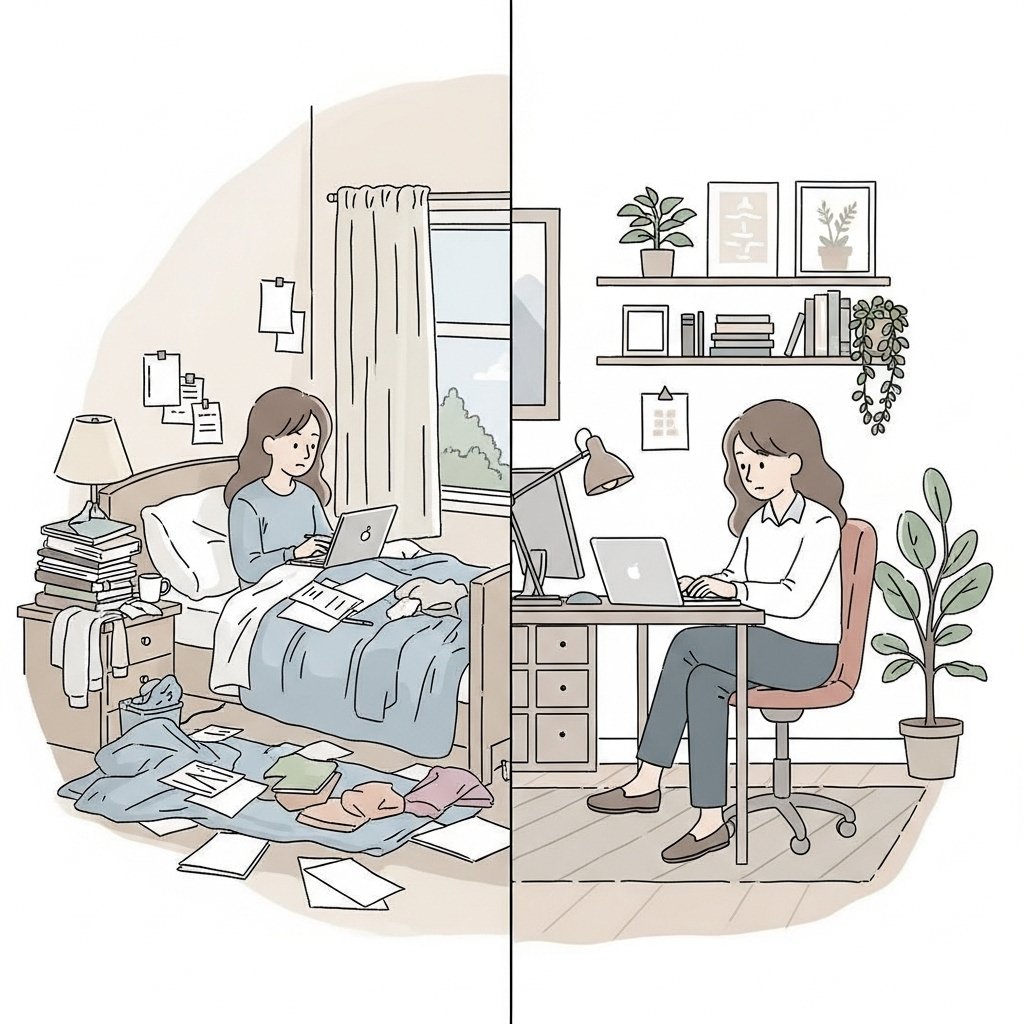
The transition to remote work has created an unprecedented challenge in sleep medicine: the complete dissolution of physical boundaries between work and rest environments. Research published in environmental psychology journals demonstrates that physical spaces create powerful psychological associations that influence behavior, mood, and physiological responses. When remote workers use their bedrooms as offices, they unknowingly create what researchers call “environmental conflict”—where a single space must trigger both high alertness for productivity and deep relaxation for sleep. Studies tracking remote workers’ sleep patterns before and after the widespread adoption of work-from-home policies reveal alarming trends, with research published in occupational health journals showing that individuals who regularly work in their bedrooms experience significantly longer sleep onset times, more frequent nighttime awakenings, and reduced sleep efficiency compared to those maintaining separate spaces.
The implications extend beyond sleep duration to fundamental sleep architecture. Research using polysomnography (sleep study technology) to monitor brain activity shows that individuals who work in their bedrooms spend less time in deep sleep and experience more fragmented REM sleep cycles. These changes occur even when total time in bed remains constant, indicating that the physical environment directly influences the brain’s ability to achieve restorative sleep stages. For remote workers, this represents a hidden productivity killer that often goes unrecognized until sleep problems become severe, with these effects compounding over time as environmental associations strengthen.
Environmental psychology research reveals that human brains create powerful associations between physical locations and behavioral states through a process called contextual conditioning. Studies published in behavioral neuroscience journals show that these associations operate at a neurological level, with specific environments triggering predictable changes in brain chemistry, hormone production, and autonomic nervous system activity. When a bedroom consistently triggers work-related stress responses, it becomes neurologically difficult to access the relaxation states necessary for healthy sleep initiation. Research conducted in sleep laboratories demonstrates that environmental cues in bedrooms directly influence melatonin production and core body temperature regulation—two critical physiological processes for sleep onset.
The conditioning effects prove remarkably persistent once established. Research tracking individuals who attempt to restore bedroom-only sleep environments after months of bedroom office use shows that it can take 4-8 weeks for the brain to fully dissociate work stress from the sleep environment. However, studies also demonstrate that individuals who successfully maintain strict bedroom boundaries report significantly better sleep quality, reduced work-related anxiety, and improved work-life balance satisfaction compared to those with mixed-use spaces. Your brain needs clear environmental cues to distinguish between work mode and rest mode, and when these boundaries blur, both your productivity and sleep quality suffer dramatically.
Bedroom = Sleep associations should include:
When you work in your bedroom, you create competing associations:
Evaluating the extent of work-sleep environment mixing requires understanding both obvious and subtle ways that work infiltrates bedroom spaces. Research published in sleep hygiene studies identifies multiple categories of boundary violations, from direct computer use in bed to more subtle issues like work-related conversations in the bedroom or charging work phones on nightstands. Studies show that even these seemingly minor intrusions can impact sleep quality through psychological pathways. Sleep research laboratories use standardized assessments to evaluate bedroom environments, focusing on what researchers call “sleep-incompatible stimuli,” which include visual reminders of work responsibilities, electronic devices with work-related notifications, and furniture arrangements that facilitate work activities.
The most insidious boundary violations often go unrecognized by remote workers themselves. Research shows that individuals frequently underestimate the impact of “minor” work activities like checking emails in bed or taking work calls from the bedroom. Studies using objective sleep monitoring reveal that these activities can delay sleep onset by 30-60 minutes and increase nighttime awakenings, even when the individual believes they’ve successfully transitioned to “rest mode.” This highlights the importance of comprehensive boundary assessment rather than focusing only on obvious work activities.
Establishing clear physical boundaries requires systematic environmental modifications supported by research in sleep hygiene and environmental psychology. Studies show that successful boundary creation involves both removing work-related stimuli from sleep environments and actively enhancing sleep-promoting environmental cues. Research published in sleep medicine journals demonstrates that individuals who implement comprehensive environmental changes see more dramatic and sustained improvements compared to those making only partial modifications. For remote workers with dedicated bedroom spaces separate from work areas, research emphasizes the importance of complete work material removal rather than simply organizing or containing work items within the bedroom.
Remote workers in studio apartments or shared spaces face more complex challenges, but research provides evidence-based solutions for creating effective boundaries within limited space. Studies testing various physical separation methods show that visual barriers (room dividers, curtains, strategic furniture placement) can create meaningful psychological boundaries even within single rooms. Research indicates that the key factor is eliminating visual connection between work and sleep areas rather than requiring completely separate rooms. Temporal boundaries—strict timing rules about when spaces serve work versus sleep functions—provide additional separation when physical distance is limited.
Immediate Actions:
Bedroom Optimization:
Workspace Setup:
Physical Separation Strategies:
Temporal Boundaries:
Create a consistent routine that signals the transition from work to rest:
Step 1: Physical Workspace Closure (5 minutes)
Step 2: Transition Activity (15-30 minutes)
Step 3: Bedroom Preparation (10 minutes)






[…] 8-10 hours a day in a state of static tension, often because we haven’t succeeded in Creating Physical Boundaries between our office and our bedroom. Specifically, our shoulders are rolled forward, our necks […]